
What if your boat's best accessory wasn't a flimsy inflatable that loses air before lunch? Every Aussie boatie knows the struggle of a cheap water carpet disintegrating under the intense UV or a heavy roll that's nearly impossible to move. You've likely felt the frustration of gear that fails just when the party starts, but you deserve a stable platform that lasts. It's time to stop settling for low-quality foam that can't handle our harsh marine environment.
Discover why a high-performance floating mat is a structural marine asset rather than just a toy and how to choose one that survives the 2026 summer. You'll learn how to identify high-buoyancy materials and ensure your gear meets the mandatory Consumer Goods (Aquatic Toys) Safety Standard 2026. We're breaking down the technical specs of UV-stabilised XPE foam and the benefits of a zero-setup design. This guide covers everything from durability secrets to safety requirements, helping you secure a product that thrives in salt water for years.
Key Takeaways
- Learn why Cross-Linked Polyethylene (XPE) foam and closed-cell technology are essential to prevent your mat from absorbing water or growing mould.
- Discover why the 3.5cm thickness is the gold standard for stability and buoyancy when choosing a water carpet for your crew.
- Understand the massive benefit of puncture-proof, zero-inflation platforms that offer instant setup for a stress-free day on the harbour or at the beach.
- Master the simple maintenance routine of rinsing and UV protection to ensure your gear survives the intense Australian sun and salt water crystal buildup.
- Explore how choosing Australian-engineered gear like the Crocpad Floating Water Mat range guarantees durability tailored specifically for our unique marine conditions.
What is a Water Carpet and Why is it Essential for Your Boat?
A water carpet is the ultimate upgrade for your vessel, transforming a standard day on the bay into a high-energy floating party. It's a high-density, multi-layered foam platform that stays on the surface without needing a single breath of air. Forget the days of struggling with noisy pumps or worrying about a sharp shell ending your afternoon. These mats offer pure, puncture-proof reliability. They've evolved significantly from the basic "lily pads" of the past into professional-grade assets that can support a whole crew of family and friends.
Boaties across Australia are making the switch because these mats are designed for our rugged conditions. When you're anchored in a quiet bay or a sun-drenched lake, you want gear that works instantly. A professional foam mat provides a stable base for kids to jump from and adults to lounge on. It's not just a toy; it's an extension of your swim platform. Whether you're hosting a lunch on the water or need a safe zone for the kids to splash around, this gear delivers a level of versatility that inflatables simply can't match.
To better understand the durability and handling of various "carpet" types in wet conditions, watch this helpful video:
Water Carpet vs Inflatable Floats: The Great Debate
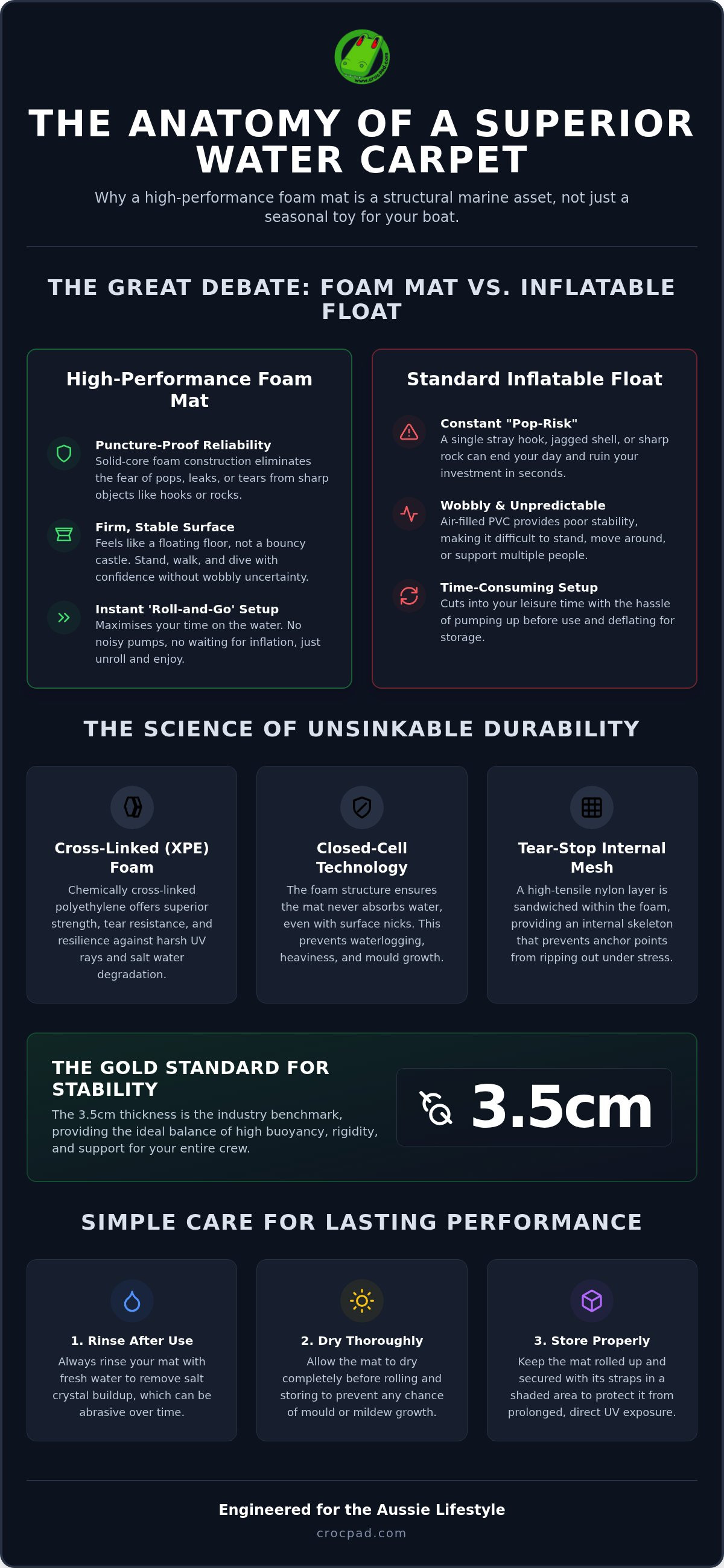
The biggest headache with inflatables is the constant "pop-risk". One stray fishing hook or a jagged rock can ruin your investment in seconds. A solid-core foam mat eliminates this fear entirely. You get a reliable surface that won't sag or leak mid-day. Stability is the other major winner here. Walking on a foam mat feels like walking on a floating floor, not a bouncy castle. You can stand, run, and dive without the wobbly uncertainty of air-filled PVC. Plus, the "roll-and-go" convenience is unmatched. While your mates are still pumping up their floats, you've already unrolled your Floating Water Mat and jumped in. It's about maximizing your time in the water and minimizing the "pump-and-deflate" hassle that usually cuts into your leisure time.
Common Names and Terminology You Will Encounter
You might hear these called lily pads, foam floats, lake pads, or floating water mats. While the names vary, the quality shouldn't. When a product is labelled "marine-grade", it means it's built to resist salt water and high UV levels. The secret lies in closed-cell foam technology, which ensures the material never absorbs water or becomes a breeding ground for mould. This structural integrity is what separates a professional water carpet from a cheap supermarket imitation. Simply put, a water carpet is a non-inflatable, buoyant foam island designed for high-performance leisure. It's the reliable choice for anyone who takes their summer recovery as seriously as their adventure, ensuring your gear lasts for many seasons to come.
The Science of Buoyancy: Understanding Foam Technology
Understanding the tech behind a water carpet is the first step to ensuring your summer investment lasts multiple seasons. Most high-end mats rely on Cross-Linked Polyethylene (XPE) foam. This isn't your standard pool noodle material. XPE is chemically cross-linked, creating a bond that is far superior in strength and environmental resilience. It's specifically engineered to handle the intense Australian sun and salt water without breaking down. Because it utilises high-buoyancy closed-cell foam, the mat won't absorb water even if it gets a surface nick. This prevents it from becoming heavy, waterlogged, or a breeding ground for mould, keeping your boat clean and your gear lightweight.
Professional-grade mats often feature "tear-stop" technology. This involves a specialised nylon mesh or a high-tensile layer sandwiched between the foam plies. This internal skeleton is vital for durability. It prevents the anchor points from pulling through when the tide gets choppy or the kids get rowdy. Without this reinforcement, a foam mat is just a giant sponge waiting to rip. Weight distribution on these non-rigid surfaces is equally fascinating. The mat flexes to accommodate movement, but the high-density core ensures the surface remains buoyant enough to keep you above the waterline.
Why XPE Foam is the Gold Standard for Floatation
The secret to a premium mat is the heat-lamination process. Unlike cheap alternatives that use glue, high-quality mats are thermally fused. This means the layers won't peel apart after a few days in 40-degree heat. High-density XPE also provides the necessary rigidity for "walk-on-water" stability. You want a surface that supports your weight rather than sinking to your knees. The tactile finish is equally important; it needs to be soft enough for lounging but tough enough to resist debris and sandy feet. If you're looking for this level of engineering, exploring the Floating Water Mat range is a smart move for any serious boatie.
Weight Capacity and Buoyancy Calculations
Don't be fooled by thickness alone. While a 3.5cm mat is often the sweet spot, the foam's density determines the actual weight capacity. A lower-density mat might be thicker but will sag significantly under a group of adults. Buoyancy is a direct result of foam volume and air-cell density working together. For example, a high-quality 3.65m mat can typically support a weight capacity of 400kg, which easily accommodates a large group of kids or several adults. Spreading the load allows the foam to displace water effectively, keeping everyone high and dry. Always check the rated capacity before loading up the whole crew to ensure everyone stays safe and afloat.
Choosing Your Perfect Mat: Size, Thickness, and Features
Selecting the right water carpet for your vessel requires more than just picking the brightest colour. You need to match the dimensions to your crew size and your boat's deck capacity. A mat that's too small leaves half the family stuck on the boat, while one that's too large becomes a nightmare to roll up and store. Most Australian boat owners find the 3.5cm thickness to be the perfect balance. It's thick enough to support adult weight without the excessive bulk that makes a mat impossible to handle alone. This thickness provides the structural integrity needed to walk across the surface without sinking to your shins.
Consider your storage footprint before you commit. You'll likely store the mat on your swim platform or strapped to the bow rails. A high-quality Floating Water Mat is designed to roll tightly, ensuring it doesn't obstruct your view or movement while cruising. Integrated tethering systems are another essential feature. Without a secure way to anchor the mat, a slight tide change or a passing wake can send your platform drifting toward the horizon. Look for systems that allow for quick attachment and release so you can spend more time swimming and less time fiddling with ropes.
Size Guide for Different Water Activities
- Small Mats (approx 2m to 2.5m): These are ideal for solo relaxation or a "couples retreat". They're incredibly easy to manage and perfect for smaller bowriders, tinnies, or even taking to the local creek.
- Medium Mats (approx 3.65m to 5.5m): The sweet spot for family use. With a weight capacity of roughly 400kg, these mats accommodate several adults or a group of energetic kids comfortably.
- Large "Party" Mats: These are designed for massive raft-ups and social gatherings. They create a massive footprint that acts as a central hub for multiple boats, providing plenty of space for lounging and socialising.
Essential Hardware: Tethers, Straps, and Anchors
Tidal waters and coastal breezes require heavy-duty hardware to keep your water carpet in place. Look for mats with reinforced D-rings or grommets. These components are vital because they distribute tension across the foam layers, preventing the anchor point from ripping through the material. A bungee tether is your best friend in choppy conditions. It acts as a shock absorber, taking the strain off both the mat and your boat's cleats. High-quality storage straps are equally important. They keep your mat compressed and tidy, making it easier to transport in the back of the ute or store in the garage between trips. Investing in marine-grade hardware ensures your setup remains secure regardless of the conditions.
Beating the Heat: Care and Maintenance in Australia
The Australian sun is relentless. While your gear is engineered for performance, even the toughest marine-grade foam requires a basic maintenance routine to survive a decade of summers. The primary enemy of any water carpet is the extreme UV index found across our coastlines. High radiation levels can eventually break down the cellular structure of inferior foams, leading to a brittle surface. Beyond the sun, salt water is a silent culprit. When salt water evaporates, it leaves behind microscopic crystals. These crystals act like sandpaper between the foam layers if the mat is rolled up while dirty, causing unnecessary internal wear.
Physical handling also dictates how many seasons your mat will last. It's tempting to drag your platform across a concrete boat ramp or over a rocky shoreline, but this is a recipe for disaster. Even though XPE foam is tear-resistant, sharp oyster shells or jagged bitumen can gouge the protective outer skin. Always use the integrated handles or get a mate to help you carry the roll. Treat your gear like a structural part of your boat. By avoiding abrasive surfaces and ensuring a clean environment, you'll maintain the sleek finish and high buoyancy that makes these platforms so enjoyable.
UV Stabilisation and Colour Longevity
When you see a product labelled as "UV-stabilised", it means specific chemical inhibitors were added to the foam during the manufacturing process. These additives absorb or reflect harmful radiation, preventing the polymer chains from snapping. You can spot signs of sun damage early by looking for "chalking". This is a fine, powdery residue on the surface, or a noticeable hardening of the foam. To prevent this, never leave your mat unrolled on the deck for days when the boat is moored. Use a breathable cover or store it in a shaded locker. Protecting your investment from direct, stationary exposure is the easiest way to keep those vibrant colours from fading.
Cleaning and Wintering Your Floating Mat
Cleaning your platform doesn't require a chemistry degree. Stick to mild dish soap and a soft brush for stubborn bird droppings or algae. Avoid harsh bleach or petroleum-based cleaners, as these can strip the UV-resistant coating and damage the heat-laminated bonds. Before you roll the mat for long-term storage, ensure it's completely dry. Trapping moisture inside a tight roll leads to "permanent curl", where the mat refuses to lie flat the next time you hit the water. Performing a thorough freshwater wash-down after every single ocean session is non-negotiable for preventing salt-related degradation. If you want a platform built to handle these specific Aussie challenges, check out the durable Floating Water Mat range designed for our unique climate.
The Crocpad Advantage: Engineered for the Aussie Lifestyle
Crocpad stands out as the local expert that truly understands the brutal reality of an Australian summer. While international competitors might offer generic solutions, our gear is specifically engineered for the high-intensity marine environments found from the Whitsundays to the Great Australian Bight. Choosing a water carpet from an Australian-owned brand means you're getting a product tested against our specific UV levels and salt concentrations. The durability of the Floating Water Mat range isn't just a marketing claim; it's a result of rigorous design standards aimed at providing long-term value for every Aussie boatie.
We prioritise your enjoyment by ensuring our products are portable, easy to handle, and incredibly resilient. You aren't just buying a piece of foam; you're investing in a reliable adventure partner. This local expertise ensures that every mat we sell is capable of withstanding demanding conditions while remaining a safe, high-performance platform for your family. Our team understands that leisure time is precious, so we focus on gear that requires zero setup time and delivers maximum fun from the moment you hit the water.
Beyond the Mat: A Complete Waterpark Setup
Building the ultimate aquatic playground is easy when you have the right ecosystem of gear. You can transform your boat's stern into a full-scale entertainment hub by pairing your water carpet with one of our high-energy additions. These products are designed to work in synergy, creating a versatile space for every member of the crew. Consider these combinations for your next trip:
- The Social Hub: Add a Beer Pong Floating Mat to the centre of your setup for a competitive social experience that keeps everyone cool and engaged.
- The Adventure Zone: Attach a Mikros Pool Slide or a Megalo 3M Inflatable Water Pool Slide to your vessel to create an instant waterpark that keeps the kids entertained for hours.
- Pet-Friendly Access: Ensure your four-legged mates don't miss out on the action by using our Inflatable Dog Ramps alongside your floating platform, making it easy for them to climb back on board safely.
Why Local Expertise Matters for Marine Gear
Buying from an Australian-owned and operated brand offers peace of mind that international retailers simply can't match. When you have a question about anchoring in a specific tidal zone or need advice on storage, you're talking to experts who live and breathe the same lifestyle. We offer fast national shipping and customer service that understands the practical needs of local boaties. There's no waiting for overseas parts or struggling with time-zone differences. You get direct access to specialists who are committed to your summer recovery and performance. Upgrade your summer with a Crocpad Floating Water Mat today and experience the difference of gear designed specifically for our backyard.
Maximise Your Next Adventure on the Water
Choosing the right gear is the difference between a one-season toy and a decade of summer memories. You now know that durable marine-grade XPE foam and closed-cell technology are the secrets to a platform that stays buoyant and mould-free. By prioritising equipment engineered for harsh Aussie UV conditions, you ensure your investment survives the 2026 season and many more to follow. A high-quality water carpet isn't just for lounging; it's a stable, puncture-proof extension of your boat that requires zero setup time and delivers pure joy for the whole crew.
As an Australian-owned and operated brand, we understand exactly what your gear faces in our rugged marine environments. Don't settle for flimsy inflatables that fail just as the party hits its stride. It's time to invest in a professional-grade solution that handles the salt, sun, and sand with ease. Explore the Crocpad Floating Water Mat Collection and secure the ultimate boat accessory today. We'll see you out there on the bay!
Frequently Asked Questions
Can I leave my water carpet in the water overnight?
No, you shouldn't leave your water carpet in the water overnight. While the foam is completely waterproof, prolonged immersion encourages algae growth and allows tiny marine organisms to attach to the underside. It also increases the risk of the mat drifting if the tide turns or the wind picks up unexpectedly while you're asleep. Pull it onto the deck or beach and give it a quick rinse to keep it in top condition.
Will my dog’s claws puncture the foam water mat?
Your dog's claws are unlikely to puncture a high-quality XPE foam mat. The material is engineered with a high-density outer skin that resists typical scratches and play from pets. While a very large dog might leave minor surface marks during a frantic jump, the closed-cell structure ensures the mat remains buoyant and won't absorb water. It's a perfectly safe and stable platform for your four-legged mates to enjoy the sun.
How do I anchor a water carpet so it does not float away?
Anchor your mat using the integrated tethering system combined with a heavy-duty bungee cord. Attach one end to the mat's reinforced grommet and the other to your boat's cleat or a dedicated sandbag anchor. Using a bungee is critical because it acts as a shock absorber for waves and tides, preventing the anchor point from tearing through the foam. Avoid using rigid ropes, as these put too much direct strain on the mat in choppy water.
What is the best way to roll up a water carpet by myself?
The best way to roll a water carpet solo is to start at the end furthest from the storage straps. Use your knees to apply steady downward pressure as you roll, keeping the cylinder as tight and even as possible. Once you reach the end, slide the storage straps around the roll and cinch them down tight. This technique ensures the mat stays compact and manageable for one person to lift into a ute or boat locker.
Can I tow a water carpet behind my boat while moving?
You cannot tow a foam mat at cruising speeds or while the boat is on a plane. The water resistance creates massive drag that will likely rip the tether points right out of the foam or cause the mat to dive dangerously underwater. If you need to move a very short distance to a different anchoring spot, do so only at a slow idle speed. For any real travel, always roll the mat up and secure it safely on your deck.
How many adults can a standard 5.5m floating mat safely hold?
A standard 5.5m mat can safely hold approximately 6 to 8 adults, provided they don't exceed the total weight capacity. Most premium mats of this length are rated for a capacity between 500kg and 600kg. To maintain the best stability, ensure your crew distributes their weight evenly across the entire surface. If too many people gather in one corner, that section will submerge while the rest of the mat tilts upward.
Does the salt water damage the foam over time?
Salt water won't rot the foam itself, but it can cause abrasive crystal buildup if the mat is left to dry without cleaning. These salt crystals can wear down the surface over time and may cause the material to feel stiff or "chalky". Performing a thorough freshwater wash-down after every session in the ocean is the most effective way to maintain the soft tactile feel and protect the foam's structural integrity.
How do I repair a small tear in the foam surface?
Small nicks or surface tears can be repaired using a flexible, waterproof marine adhesive or a specialised foam sealant. Because the mat utilises closed-cell technology, a minor surface tear won't cause the platform to absorb water or lose its buoyancy. Clean the damaged area with fresh water, let it dry completely, and apply the adhesive as directed. For very small scuffs, most boaties find they don't affect performance and simply leave them as part of the mat's character.