
Your average inflatable boat float is usually one stray fishing hook or an excited kelpie away from becoming a piece of floating rubbish. Most Aussie boaties have experienced that sinking feeling when a cheap mat starts losing air before the first snag is even off the barbie. It's frustrating to invest in summer fun only to have it perish under the brutal sun or take up far too much deck space when you're trying to cruise.
We agree that your time on the water is too precious to waste on gear that can't keep up with an active lifestyle. You deserve a marine-grade extension of your boat that acts as a puncture-proof island for the whole family. This guide promises to show you exactly how to choose, secure, and maintain the perfect boat float to transform your next day out into an epic floating playground for the 2026 season.
We'll preview the latest UV-stabilised materials designed for the Australian heat, clever storage solutions for tight decks, and the essential safety standards you need to keep the kids and the family dog secure while they play.
Key Takeaways
- Learn why a marine-grade boat float is the superior choice over flimsy inflatables for expanding your usable deck space.
- Discover the science behind XPE foam and UV stabilisation to ensure your mat survives the intense Australian sun without fading or crumbling.
- Master the art of calculating weight capacity so you can safely host the whole crew while keeping your deck clear and organised.
- Get professional tips on secure tethering and positioning to keep your floating playground away from propellers and exhaust fumes.
- Find out why choosing gear designed for local saltwater conditions ensures your investment lasts for many summers to come.
What is a Boat Float? Expanding Your Deck Space
Forget the mechanical lifts or industrial pontoons you might find in a dry dock. When we talk about a modern boat float, we're referring to a high-density, recreational foam island that tethers directly to your vessel. It's essentially a marine-grade extension of your swim platform. To understand the fundamental physics behind these structures, it's helpful to look at the broader nautical definition of What is a Boat Float? and how buoyancy keeps objects topside in various marine environments.
Aussie boaties are rapidly ditching flimsy, single-person lilos for these expansive mats. Why? Because a lilo is a solo experience that usually ends with someone falling off and drifting away. A large foam mat creates a communal hub. It's a mobile island where the whole crew can congregate, effectively doubling your boat's social footprint. You gain square metres of usable real estate without the eye-watering fuel costs or the maintenance required for a larger vessel. It's the smartest way to upgrade your boat's capacity for the 2026 season.
To better understand this concept, watch this helpful video:
Floating Mats vs. Inflatables: The Verdict
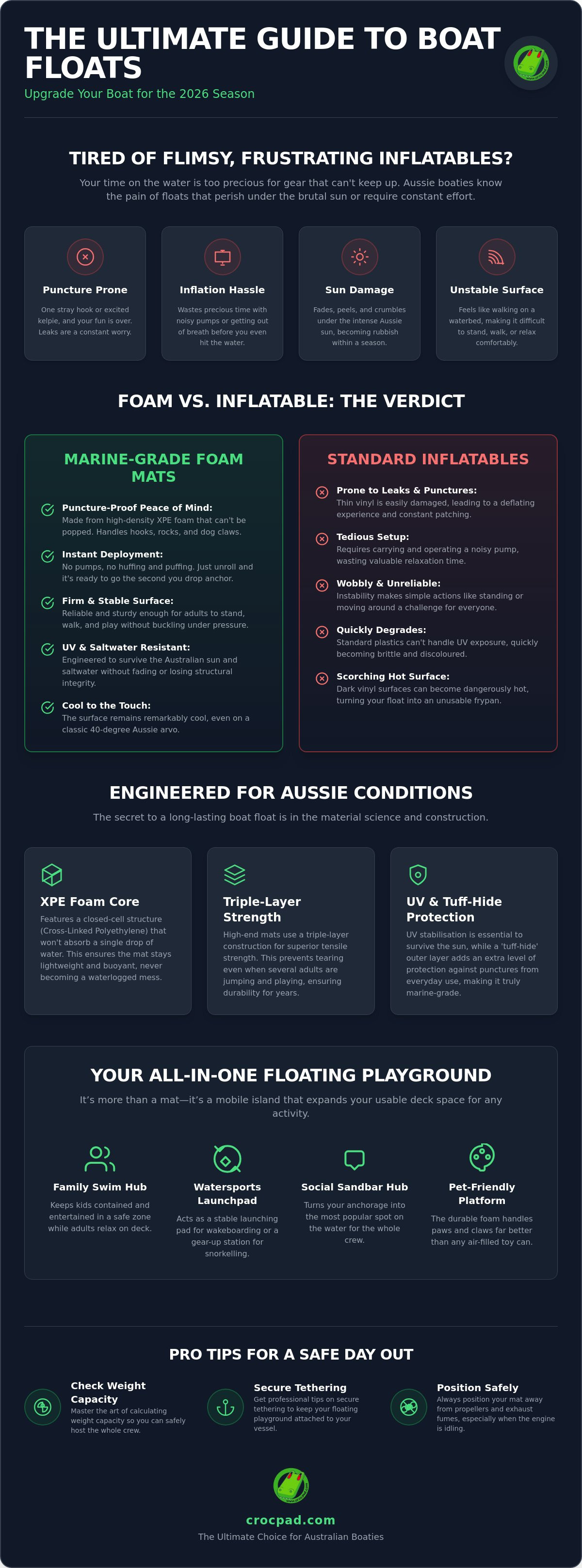
Choosing a foam mat over an inflatable is a total game-changer for day trips. You don't need to lug a noisy air pump or waste twenty minutes of your arvo huffing and puffing on the deck. Foam mats are ready to deploy the second you drop anchor. They offer puncture-proof peace of mind, which is vital when you're tucked into a rocky cove or a snag-heavy river bend. Unlike thin vinyl inflatables that feel like walking on a waterbed, a high-quality Floating Water Mat provides a firm, reliable surface. It's stable enough for adults to stand, walk, or even perform a cheeky backflip without the whole thing buckling under pressure.
Common Uses for Boat Floats in Australia
These mats serve as the ultimate family swimming hub. They keep the kids contained and entertained in a safe zone while the adults kick back on the deck with a cold one. For the more adventurous, they act as a stable launching pad for wakeboarding transitions or a gear-up station for snorkelling sessions. If you're heading out for a social Sunday at the sandbar, the Beer Pong Floating Mat turns your anchorage into the most popular spot on the water. Even the family dog can join in, as the durable foam handles paws and claws far better than any air-filled toy. Just remember to tether your boat float away from the transom to avoid any exhaust fumes or propeller hazards while the engine is idling.
Why Marine-Grade Foam is the King of Boat Floats
While inflatables rely on a thin layer of air to keep you up, a high-quality boat float uses the inherent buoyancy of XPE (Cross-Linked Polyethylene) foam. This material is the undisputed king of the water for a reason. It's a closed-cell structure; it won't absorb a single drop of water even if it's submerged all day. You won't have to worry about your mat becoming a heavy, waterlogged mess that's impossible to roll up at the end of the trip.
Resilience in the Australian marine environment is about more than just staying afloat. Saltwater is notoriously aggressive on recreational gear, often causing standard plastics to peel or perish within months. Marine-grade foam is specifically engineered to withstand constant salt exposure without losing its structural integrity. It also solves the problem of "hot feet" on those classic 40-degree arvos. The surface of a premium mat remains remarkably cool compared to the scorching vinyl of an inflatable, allowing you to lounge comfortably without feeling like you're on a frypan.
XPE Foam Layers and Durability
Durability comes down to the internal architecture of the mat. Most high-end options utilise a triple-layer foam construction that provides superior tensile strength. This layering prevents the mat from tearing when several adults are jumping on it at once. A "tuff-hide" outer layer adds an extra level of protection against punctures from fishing hooks, oyster rocks, or the family dog's claws. For any serious boatie, high-density foam is a non-negotiable requirement for a boat float that actually lasts.
The Role of UV Protection
The Australian sun is famously brutal on anything left on deck. Standard plastics can become brittle and start crumbling after just one season of exposure to high UV levels. UV stabilisation in 2026 involves the integration of chemical blockers that prevent polymer breakdown, a critical feature as the Australian marine equipment market hits a record $2.8 billion in value. Investing in a Floating Water Mat with advanced UV protection ensures your island stays vibrant and strong for years, not just weeks.
Choosing the Right Size and Capacity for Your Vessel
Selecting the perfect boat float depends entirely on the size of your crew and the layout of your vessel. While it's tempting to buy the largest mat available, you must consider how much deck space you're willing to sacrifice during the cruise. A massive 5.5-metre mat might be the ultimate party island, but if it blocks your access to the motor or the helm on a smaller boat, it becomes a safety hazard rather than an asset. You need to find the sweet spot between maximum fun and operational ease.
Buoyancy is the most critical factor when calculating capacity. It isn't just about how many people can fit on the surface; it's about how much weight the foam can displace before it starts to submerge. For example, a standard 3.6-metre Floating Water Mat is usually rated for approximately 400kg. This is perfect for a small family or four average-sized adults. If you're planning on hosting the whole neighbourhood, you'll need to step up to a thicker, longer model to ensure everyone stays high and dry above the waterline.
Small vs. Large Floating Mats
For couples or small families heading out in a tinny or a compact runabout, a 2.5-metre to 3.6-metre mat is the ideal choice. These sizes are manageable for one person to deploy and roll back up without a struggle. If you own a large pontoon boat or a cruiser with a wide swim platform, you can easily justify a 5.5-metre boat float. To get the best performance out of these larger mats, always practice smart weight distribution. Keep the adults towards the centre of the mat and let the grommets play around the edges to prevent the foam from dipping too deep in one spot.
Transport and Portability Tips
Storage is often the biggest pain point for boaties, but a bit of organisation goes a long way. Always measure your available deck space or the width of your swim platform before you commit to a specific model. When it's time to head home, roll your mat as tightly as possible, similar to a sleeping bag, to minimise its footprint. Secure it with heavy-duty webbing straps rather than cheap ropes that can slip or fray. We recommend keeping your bungees, carabiners, and straps inside Waterproof Bags; this prevents them from getting tangled in your fishing gear or lost in the dark corners of your cabin storage.
Setup and Safety: Securing Your Float in Open Water
Properly securing your boat float is the difference between a relaxing arvo and a stressful rescue mission. A large mat acts like a sail in the wind; it will drift surprisingly fast if your tether fails. Always use the "tether and forget" method by utilising high-quality bungees and carabiners. This ensures your mobile island stays exactly where you put it. Positioning is equally critical for safety. Never tether your mat directly behind the transom if there's any chance the engine will be idling. You must keep the swimming area clear of propellers and dangerous exhaust fumes to ensure everyone stays healthy while they play.
Currents can change in an instant, especially in tidal estuaries or near river mouths. We recommend always keeping a visual on the horizon to ensure you aren't drifting toward other vessels or hazards. If you're anchored in a busy channel, consider using a bright safety flag on the corner of the mat to increase visibility for passing jet skis and tinnies. Safety is about being proactive, not reactive.
The Proper Way to Anchor a Mat
Most premium mats come equipped with built-in D-rings or reinforced grommets. Use these dedicated attachment points rather than wrapping ropes around the foam, which can cause tearing over time. A bungee tether is your best friend here because it absorbs wave shock. When a passing boat creates a wake, the bungee stretches and retracts, preventing the boat float from jerking violently against your boat's cleats. If you've found a perfect shallow spot away from the vessel, you can secure the mat directly to a sand anchor. This keeps the deck clear while providing a stable base for snorkelling or sunbathing.
Pet Safety and Water Access
Aussie boat dogs are part of the family, and they usually want to be right in the middle of the action. While the durable XPE foam handles claws well, the real challenge for pets is getting back onto the boat from the water. A wet dog trying to scramble up a metal ladder is a recipe for injury. To make your vessel truly pet-friendly, we suggest using an Inflatable Dog Ramp alongside your mat. This creates a gentle, non-slip incline that allows your mate to swim on and off the mat without assistance. It's a game-changer for older dogs or smaller breeds that lack the reach to climb back aboard.
Supervising the grommets is non-negotiable. Even though these mats are incredibly stable, the June 2026 update to the Consumer Goods (Aquatic Toys) Safety Standard reminds us that water safety requires constant vigilance. Ensure kids under 12 are wearing lifejackets that meet the AS 4758 standard, especially if you're anchored more than 400 metres from the shore. Establish a clear "no-go zone" around the motor and ensure everyone knows how to safely climb back onto the mat if they fall off during a wrestling match.
Why Crocpad is the Ultimate Choice for Australian Boaties
Choosing the right gear means trusting the people who actually use it in our local waters. Crocpad is designed by Aussies who understand that a Sunday on the Hawkesbury or a trip out to the reef requires equipment that won't perish after three months. We've built our reputation on providing a boat float that handles the unique demands of the Australian marine environment. From the specialised XPE foam to our UV-stabilised coatings, every detail is engineered for longevity and high performance.
The versatility of our range sets us apart from generic imports. Whether you're looking for a massive Floating Water Mat for the whole family or want to turn your vessel into a theme park with the Megalo 3M or Mikros Pool Slide, we have the specialised gear to make it happen. We support the national boating community with expert advice and products that are actually fit for purpose. You aren't just buying a mat; you're joining a community of adventurers who demand the best from their leisure time.
The Crocpad Difference: Quality You Can Feel
Our "Buy Once, Cry Once" philosophy is about investing in quality that lasts. Cheap alternatives often use low-density foam that tears under the weight of a few adults. In contrast, the Crocpad boat float features a puncture-resistant surface that stands up to heavy use. For those who take their social life as seriously as their boating, our Beer Pong Floating Mat is the ultimate addition to any sandbar gathering. It's stable, durable, and designed to be the centre of attention for years to come. You can feel the structural integrity the moment you step onto the surface.
Getting the Most Out of Your Investment
Protecting your gear is simple but essential. Always give your mat a thorough rinse with fresh water after a salty arvo to prevent salt crystal buildup. This simple habit preserves the "tuff-hide" outer layer and keeps the colours vibrant. When the temperature finally drops, ensure your mat is completely dry before rolling it up for winter storage. Keep it in a cool, dry place away from direct sunlight during the off-season. This small amount of care ensures your island is ready to deploy the moment the first warm breeze of spring hits. Ready to upgrade your vessel? Shop the Crocpad Floating Water Mat collection today and transform your summer.
Ready to Claim Your Own Floating Island?
Transforming your vessel into the ultimate social hub is about more than just adding an accessory; it's about choosing gear that survives the reality of the Australian coast. We've explored why high-density XPE foam is the gold standard for puncture resistance and how smart tethering keeps your crew safe from drifting. You now have the knowledge to select a boat float that balances weight capacity with easy storage, ensuring your deck remains organised while the fun stays on the water.
As an Australian owned and operated business, we take pride in building equipment that stands up to our brutal UV levels. Our mats feature heavy-duty UV-stabilised XPE foam designed for years of saltwater use, not just a few weeks. With fast national shipping available for the 2026 summer season, your next trip to the sandbar could be your best one yet. It's time to ditch the flimsy inflatables and invest in a surface that handles the whole family plus the dog.
Upgrade your boat day with a Crocpad Floating Water Mat and experience the difference of marine-grade durability. We'll see you out there on the water!
Frequently Asked Questions
Can I tow my floating water mat behind the boat while moving?
No, you should never tow a foam mat behind a moving vessel. These mats are designed for stationary use while anchored. The drag created by even low speeds can tear the reinforced grommets or damage the internal foam structure. Always roll it up and secure it on your deck or swim platform before heading to your next spot.
How do I clean my boat float after a day in saltwater?
Simply rinse your mat thoroughly with fresh water after every use. Salt crystals can be abrasive and may degrade the surface over time if left to dry. If you've had a particularly messy arvo, use a soft cloth and a mild, eco-friendly detergent to wipe away any grime. Ensure the boat float is completely dry before rolling it up for storage to prevent mould.
Is the foam mat safe for my dog's claws?
Yes, the high-density XPE foam is specifically engineered to be puncture-resistant. Unlike inflatable toys that pop at the first sign of a claw, our mats handle paws with ease. The "tuff-hide" outer layer provides a durable surface that won't shred or peel. It's the perfect way to let your four-legged mate join the family in the water safely.
How much weight can a standard Crocpad Floating Water Mat hold?
Weight capacity depends on the specific dimensions of your mat. A standard 3.6-metre model is designed to support approximately 400kg, which easily accommodates a small group of adults and kids. Larger 5.5-metre versions can handle over 600kg. Always distribute weight evenly across the surface to maintain maximum buoyancy and keep everyone above the waterline.
What is the best way to store a boat float when not in use?
Roll the mat as tightly as possible and secure it with heavy-duty webbing straps. Store it in a cool, dry area away from direct sunlight to prevent any long-term UV damage. If you're storing it for the winter, make sure it's 100% dry inside and out. Using a dedicated storage bag can also help protect the edges from accidental scuffs while it's in the garage or cabin.
Do I need a pump for a foam floating water mat?
No, you'll never need a pump or any inflation equipment for these mats. They are made from solid, closed-cell XPE foam that provides instant buoyancy the moment it hits the water. This makes a boat float far more convenient than traditional inflatables. You can deploy it in seconds and get straight to relaxing without wasting time on the deck with a noisy air pump.
How do I stop my boat float from drifting away in the wind?
Use a high-quality bungee tether and a marine-grade carabiner to secure the mat to your boat's cleats. The bungee acts as a shock absorber, preventing the mat from jerking when waves or wind hit. If you're away from the boat, you can also secure the tether to a small sand anchor in shallow water. This keeps your island exactly where you want it all arvo.
Can I use the floating mat in a backyard pool as well?
Yes, these mats are perfectly safe for use in chlorinated or saltwater backyard pools. They provide a stable, fun platform for kids to play on without the risk of popping or leaking. Just remember to give the mat a quick fresh-water rinse after pool use to remove any chemical residue. It's a versatile investment that works just as well at home as it does on the lake or at the beach.